
Concrete is an essential material for outdoor features such as balconies, steps, walkways, landings and parking areas. Its durability depends not only on the mix, but also on a range of technical factors that must be addressed from the outset.
Strength (MPa), air entrainment, reinforcement, thickness, base preparation, formwork and curing all directly affect the quality of the result. Poorly installed concrete can crack, settle or deteriorate prematurely.
Here are the essential factors to understand for a lasting project.
MPa (megapascals) measures the compressive strength of concrete. The higher this number, the greater the loads the concrete can support.
The appropriate MPa rating depends directly on the intended use. Unsuitable concrete can lead to premature wear.
In a climate like ours, air entrainment is essential.
Concrete is very strong in compression but weaker in tension. Reinforcement compensates for this weakness.
Uses:
Typical spacing:
Uses:
Reduces microcracks, but does not always replace steel reinforcement.
Reinforcement must be:
A slab that is too thin almost always leads to cracks.
Thickness must be suited to the intended use and soil conditions.
It all starts beneath the concrete.
Essential steps:
A poor base = settlement and cracks.
Concrete allows a wide variety of shapes and finishes, but they must be properly executed to prevent long-term problems.
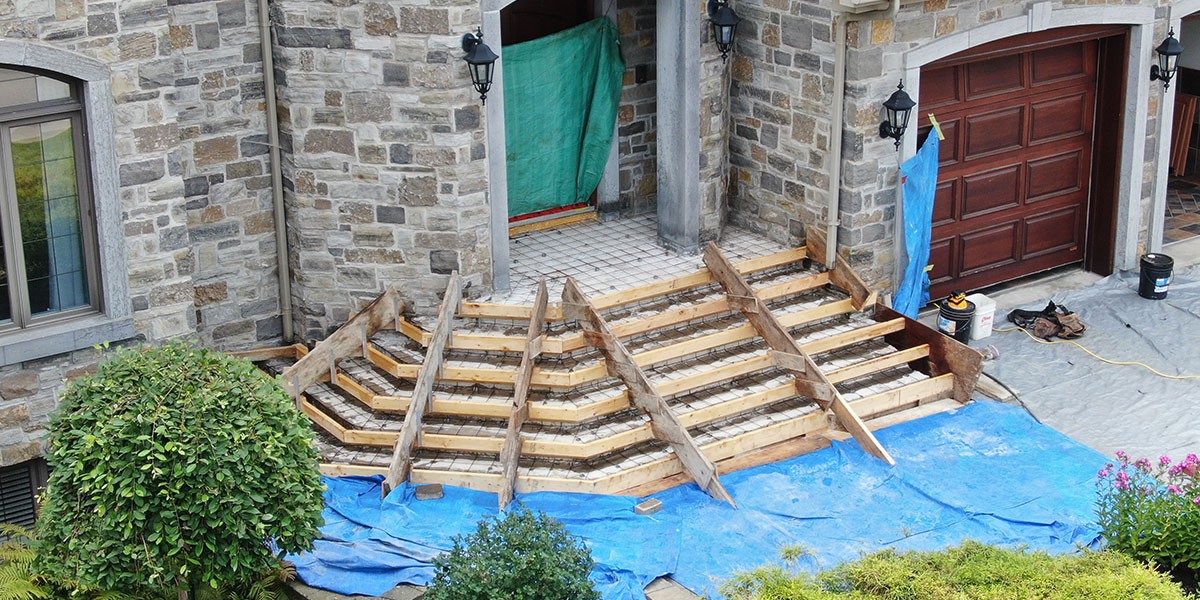
Steps are critical areas:
Stresses:
Recommendations:
Bullnose (rounded edging) is widely used for:
Benefits:
Important :
Formwork requires:
An error at this stage affects the entire final result.
Concrete naturally cracks. The goal is to control those cracks.
Concrete does not simply dry; it hardens through a reaction with water.
Proper curing provides:
Some cracks are normal if they are controlled.
They are problematic if they are:
Durable concrete depends on several factors:
Quality depends on more than the concrete itself…
it comes from the entire system and how it is installed.


I am a contractor, consultant and digital strategist.
Since 2009, I have been developing my own web platforms in the construction industry. These strategies have generated over $700,000 in actual revenue.
I founded Paysagement Expert in 2015, followed by Travaux Experts as a general contractor. I learned to build on job sites before building in the digital world.
Today, through LeProduweb, I help small and medium-sized businesses integrate artificial intelligence to modernize their marketing, organize their operations and accelerate their growth.
AI that works for entrepreneurs. Not the other way around.

Paysagement Expert provides professional landscaping, outdoor maintenance and property enhancement services for residential and commercial clients. The company focuses on quality, durability and personalized service tailored to each client’s needs.

Travaux Experts offers specialized renovation, maintenance and general contracting services. With extensive on-site experience, the company provides reliable, effective solutions tailored to the requirements of residential and commercial projects.

Asphalte Expert specializes in asphalt paving and maintenance for residential and commercial properties. The company offers durable, professional solutions suited to our local climate.
Réparation Acrylique specializes in repairing and protecting exterior surfaces such as balconies, foundations, concrete structures and walls. The company provides durable solutions to improve the waterproofing, strength and longevity of residential and commercial structures.
5809-7098-01